
 |
Position Papers
Postpartum doulas support families
Present health care practices in much of the developed world, combined with a lack of cultural rituals leave families virtually unsupported in the crucial year of childbirth. There is a great deal of evidence suggesting that quality support can ease the transition that comes with the addition of a baby to the family. By educating, attending to the needs of the parents, infant and children and by offering quality referral information, the postpartum doula can ease and enhance the postpartum experience. Every family can benefit from the support and encouragement offered by a doula during the fourth trimester.

The Postpartum Doula’s Role in Maternity Care
A DONA International Position Paper
The birth of a baby represents a profound and permanent
life change for the parents and other family members.
After nine months of pregnancy and the stresses of labor
and birth, a family is born or enlarged. For new parents the
challenges are numerous recovery from birth; total
responsibility for a tiny dependent newborn; sleeplessness;
emotional adjustment; mastery of infant feeding and care;
understanding of and adjustment to the unique personality
of their baby; and household organization. Sometimes the
physical or emotional health of the new mother or baby is
compromised, and the parents need more support at home
than they had expected.
Furthermore, many new parents are unaware of what
constitutes normal newborn growth and development, and
normal postpartum recovery for the mother. Typically,
they visit the baby’s doctor and their maternity caregiver
infrequently, which sometimes means that they and their
babies undergo unnecessary stress and hardship because
they do not know when to ask for help.
In our society, many new parents find themselves ill prepared
for this transition and isolated from caring,
knowledgeable helpers and advisors. In times past, new
parents could usually depend on their own parents, other
family members or friends to assist them. While these
resources are still available today, they are frequently
spotty and inadequate, due to great distances between new
parents and their loved ones, and other demands on loved
ones that take priority over the new family’s needs.
With all these challenges, it is clear that the importance of
support, advice and assistance in the weeks and months
following birth cannot be overemphasized. The ways in
which the woman, baby, partner and siblings make the
transition to a new family unit have a long-term impact on
their physical and emotional health. The postpartum doula
fills a large gap in maternity care and is able to facilitate a
smooth and rewarding transition.
Research by experts tells us what many have long
suspected: that those new parents who have support and
feel secure and cared for during this time are more
successful in adapting than those who don’t. Studies have
shown that cultures in which women are cared for by
others for a defined period of days or weeks and are
expected only to nurture themselves and their babies
during that time have superior outcomes in postpartum
adjustment (1-2). We know that women who experience
support from their family members, care providers,
counselors and peer groups have greater breastfeeding
success (3-10), greater self-confidence (11-15), less
postpartum depression (16-21) and a lower incidence of
abuse than those who do not (22-24).
There is also evidence indicating that timely referrals to
competent, appropriate professionals and support groups
can have a significant positive outcome for the family
(11, 18, 20, 21, 25). Parents benefit from education on what
to expect from a newborn, baby-soothing skills, feeding,
bonding and attachment and coping skills (3, 13, 26-30).
Rather than being told to "help out", partners and other
family members benefit from concrete instruction and role
modeling on how to support a woman during the weeks
after birth. Research tells us that support for and from the
partner can have a significant impact on their partner's own
experience as well as the emotional adjustment of the
mother (3, 8, 17-21, 31-36).
This paper presents the position of DONA International on the benefits
of a doula’s support in the weeks after birth, with
references to the medical and social sciences literature. It
explains the role of the doula with the family, and within
the context of postpartum health care. Terminology
relating to doula care is also explained.
^Top
Role of the Doula
In traditional societies women and men grow up around
birth, breastfeeding, infants and children. After giving
birth, women are surrounded by caring family members
who have a great deal of experience and wisdom to offer.
This kind of help is rarely available to new parents internationally. The doula’s support is intended to fill the
gaps left by our customary postpartum practices, which
usually include only medical procedures, occasional
checkups and the purchase of baby-related paraphernalia.
The doula’s education, quiet support and guidance are a
manifestation of the traditional postpartum support that our
society is missing.
Doulas are trained in postpartum adjustment, newborn
characteristics, care, feeding and development, and the
promotion of parent-infant bonding. They are experienced
in supporting families through their postpartum
experience. Coming into the home during the fourth
trimester following birth, the doula’s role is to provide
education, non-judgmental support and companionship,
and to assist with newborn care and family adjustment,
meal preparation and light household tasks. Postpartum
doulas offer evidence-based information on infant feeding,
emotional and physical recovery from birth, infant soothing and coping skills for new parents and can make
appropriate referrals when necessary.
The doula can serve as a "buffer" for new parents, who
receive a great deal of unsolicited and possibly outdated
advice. The doula can help friends and family members to
foster and support the parenting decisions of the new
parents. By modeling a deep respect for the wisdom and
decision making abilities of the new parents, she makes
clear that supporting them in their own choices will have
the best possible results.
By dedicating herself to the family in this way, the doula
validates and enhances the parents’ intuitive ability to
nurture and encourages them to develop and implement
their own parenting style.
See Postpartum Support Terminology (right)
^Top
Doulas and Families
The doula’s goal is to facilitate the transition to parenthood
by supplying reliable and factual information, reassurance
and hands-on support with children and household
organization. By "mothering the mother", the doula
enables the new mother to recover from pregnancy and
birth and focus her energy on bonding with her new baby.
Parents are able to care for their children with the
reassurance that non-judgmental support and an extra set
of hands are available when they need them. Through this
support, the doula is able to help parents and older children
integrate the baby into the family in a loving, gentle
manner.
Doulas as Members of the Postpartum Care Team
The role of the doula is one of non-medical support.
Healthcare professionals such as doctors, midwives, nurses
and others are responsible for the health and well-being of
mother and baby. The non-medical support of the doula
meets the practical and psycho-social needs of the family.
The doula’s knowledge of the changes that come with a
new baby enables her to enhance communication both
within the family and with other support professionals. The
doula is also available to make referrals to quality care
providers such as lactation consultants, pediatricians,
counselors and support groups, when appropriate.
Research Findings
In order to define the role of the postpartum doula and
determine her scope of practice, DONA International undertook a study
of existing literature on factors that influence postpartum
recovery and adjustment and identified which of these
might be offered by non-medical professionals. These
have been included in the tasks that comprise the doula’s
role, along with other factors, including the family’s
perceptions of their own needs for supportive nurturing.
Services and Costs
Most postpartum doulas and doula agencies are
independent and are employed directly by the parents.
They usually have phone contact and often meet prenatally
with clients to assess their needs and establish a
relationship. Doulas offer a variety of flexible schedules
for providing support, which can include full days, part days,
overnights and weekends.
Some doulas work as individuals, while others are
employed by agencies or are members of doula
cooperatives. Still others are available through community
service organizations. Costs for doula services vary geographically. Most doulas
charge an hourly fee for their services, and many base their
fees on a sliding scale.
There is growing third party insurance reimbursement for
postpartum support. Grant funding is a possibility for
postpartum doula programs. At present, however, most
doula care is paid for directly by the client.
See Questions to Ask a Postpartum Doula (right)
^Top
Training and Certification of Doulas
Postpartum doula training focuses on preparing the doula
to support the family after birth and to help them have the
best possible outcomes. She learns about the physical and
psychological needs of the postpartum period and
development of the newborn. The doula receives training
on breastfeeding skills and support, support of the woman
with postpartum depression, support for the partner,
fostering bonding, multiples, grief and loss, and the
importance of referrals to competent and appropriate
professionals and support groups. Training includes
educating the family on infant care, newborn
characteristics, coping skills and supporting the mother.
Certification is offered by several local, national and
international organizations. Some private agencies train
their own doulas and certify them under their own business
name. Because of the variation of training practices, the
knowledge-base and qualifications of doulas can vary
greatly. This lack of consistency compelled DONA International to
research, write and implement an evidence-based program.
DONA International has exacting standards set to ensure top-quality
postpartum support internationally. This evidence based
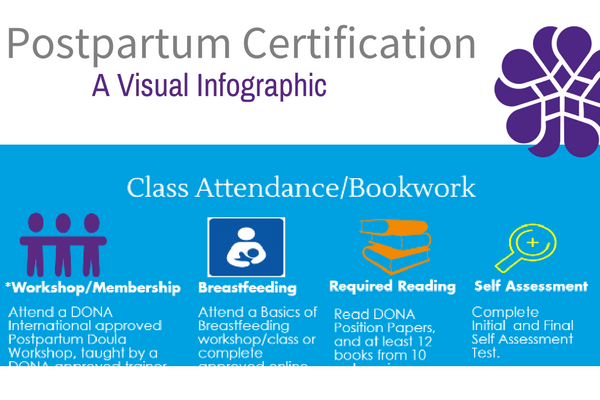
certification program includes a doula training
workshop, breastfeeding training,
background reading, the investigation and documentation
of local referrals for future clients and essays that
demonstrate understanding of the integral concepts of
postpartum doula support. Positive evaluations from
supported mothers and their partners are also required.
Summary
Present North American health care practices and a lack of
cultural rituals leave families virtually unsupported at this
important time in their lives. There is a great deal of
evidence suggesting that quality support can ease the
transition that comes with the addition of a baby to the
family. By educating, attending to the needs of the
parents, infant and children and by offering quality referral
information, the postpartum doula can ease and enhance
the postpartum experience. Every family can benefit from
the support and encouragement offered by a doula during
the fourth trimester.
^Top
References
- Kruckman, L. (1992). Rituals and support: An anthropological view of postpartum depression. In J.
Hamilton and P. Harberger (Ed.), Postpartum
Psychiatric Illness (pp. 137-148). Philadelphia, PA:
University of Pennsylvania Press.
- Stern, G., & Kruckman, L. (1983). Multi-disciplinary
perspectives on post-partum depression: An
anthropological critique. Social Science and Medicine,
17(15), 1027-1041.
- Newman, J., & Pitman, T. (2000). The Ultimate
Breastfeeding Book of Answers. Roseville, CA: Prima
Publishing.
- Deshpande, A., & Gazmararian, J. (2000). Breast-feeding
education and support: Association with the decision
to breast-feed. Effective Clinical Practice, 3(3), 116-22.
- Morrow, A. L., Muerrero, M. L., Shults, J., Calva, J. J.,
Lutter, C., Bravo, J., et al. (1999). Efficacy of homebased
peer counseling to promote exclusive
breastfeeding: A randomised controlled trial. Lancet,
353, 1226-31.
- Tarkka, M., Paunonen, M., & Laippala, P. (1998). What
contributes to breastfeeding success after childbirth in a
maternity ward in Finland? Birth, 25(3), 175-81.
- Mohrbacher, N., & Stock, J. (1997). The Breastfeeding Answer Book. Schaumburg, IL: La Leche League
International.
- Giugliani, E., Vogelhut, J., Witter, F., & Perman, J. (1994).
Effect of breastfeeding support from different sources
on mothers' decisions to breastfeed. Journal of Human
Lactation, 10(3), 151-161.
- Forman, R. D., et al. (1990). The forty-day rest period and
infant feeding practices among Negev Bedouin Arab
women in Israel. Medical Anthropology, 12(2), 207-16.
- Raphael, D. (1973). Breastfeeding:The Tender Gift. NY:
Schocken Books.
- Porteous , R., & Kaufman, K. (2000). The effect of
individualized professional support on duration of
breastfeeding: a randomized controlled trial. Journal of
Human Lactation, 16(4), 303-8.
- Haider, R., Ashworth, A., Kabir, I., & Huttly, S. (2000).
Effect of community-based peer counselors on
exclusive breastfeeding practices in Dhaka,
Bangladesh: A randomised controlled trial. Lancet,
356(9242), 1643-7.
- Terry, D. J., Mayochhi, L., & Hynes, G. J. (1996).
Depressive symptomatology in new mothers: A stress
and coping perspective. Journal of Abnormal
Psychology, 105(2), 220-231.
- Klaus, M. H., Kennell, J. H., & Klaus, P. H. (2002).
The Doula Book. Reading, MA: Addison-Wesley.
- Cutrona, C. E., & Troutman, B. R. (1986). Social support,
infant temperament and parenting self-efficacy: A
mediational model of postpartum depression. Child
Development, 57, 1057-1518.
- MacArthur, C., et al. (2002). Effects of redesigned
community postnatal care on women's health 4 months after birth: A cluster randomized control study. Lancet,
359(9304), 378.
- Lavender, T., & Walkinshaw, S. (1998). Can midwives
reduce postpartum psychological morbidity? A
randomized trial. Birth, 25(4), 215-19.
- Locicero, A., Weiss, D., & Issokson, D. (1997). Postpartum
depression: Proposal for prevention through an
integrated care and support network. Applied and
Preventive Psychology, 6, 169-78.
- Small, R., Astbury, J., Brown, S., & Lumley, J. (1994).
Depression after childbirth: Does social context
matter? The Medical Journal of Australia, 161, 473-6.
- McIntosh, J. (1993). Postpartum depression: Women's
help-seeking behaviour and perceptions of cause.
Journal of Advanced Nursing, 18, 178-84.
- Berchtold, N., & Burrough, M. (1990). Reaching out:
Depression after delivery support group network.
NAACOG. Clin. Issu. Perinat. Women's Health Nurs.,
1(3), 385-94.
- Contact: Prevent Child Abuse America. U.S. parents want
help with newborns: lack of experience and skill seen
as reason for increased child abuse and neglect.
Retrieved December 12, 01, from Prevent Child Abuse
America Web Site: http://preventchildabuse.org
- Hagen, E. (1999). The functions of postpartum depression.
Evolution and Human Behavior, 20, 325-359.
- Wilson , L., Reid, A., Midmer, D., Biringer, A., Carroll, J., & Stewart, D. (1996). Antenatal psychosocial risk
factors associated with adverse postpartum family
outcomes. CMAJ, 154(6), 785-99.
- Ray, K., & Hodnett, E. (n.d.). Caregiver support for
postpartum depression. Retrieved 2001, from Cochrane Database Syst Rev
- Field, T. (2001). Touch. Cambridge, MA: Bradford.
- Swain, A., O'Hara, M., Starr, K., & Gorman, L. (1997). A
prospective study of sleep, mood, and cognitive
function in postpartum and nonpostpartum women. Obstetrics and Gynecology, 3(3), 381-6.
- Klaus, M., & Kennell, J. (1995). Bonding. Reading, MA:
Addison-Wesley.
- Montagu, A. (1986). Touching: The Human Significance of
the Skin (3rd ed.). New York: Perennial Library.
- Field, T. (1990). Infancy: The Developing Child.
Cambridge, MA: Harvard
University Press.
- Arora, S., McJunkin, C., Wehrer, J., & Kuhn, P. (2000).
Major factors influencing breastfeeding rates: Mother's
perception of father's attitude and milk supply.
Pediatrics, 106(5), E67.
- Misri, S., Kostaras, X., Fox, D., & Kostaras, D. (2000). The
impact of partner support in the treatment of
postpartum depression. Canadian Journal of
Psychiatry, 45(6), 554-8.
- Kleiman, K. (2000). The Postpartum Husband. USA:
Xlibris.
- Kleiman, K. (1994). This Isn't What I Expected. USA:
Bantam.
- Cronwett, L. (1985). Parental network structure and
perceived support after birth of first child. Nursing
Research, 34(6), 347-52.
- O'Hara, M., Rehm, L., & Campbell, S. (1983). Postpartum
depression. A role for social network and life stress
variables. Journal of Nervous and Mental Disease,
171(6), 336-41.
^Top
Jacqueline Kelleher, DONA Postpartum Chair wrote this
paper with the assistance of Penny Simkin and the 2002
DONA International Board of Directors.
Download this Postpartum Doula Position Paper as PDF 
(140k PDF)
For more information about postpartum and birth doulas,
contact:
DONA International
(888) 788-DONA
www.DONA.org
To purchase copies of this paper, contact DONA International at the
number above or order them on-line in the DONA Boutique.
© DONA International 2002, 2006, 2008
Permission granted to freely reproduce in
whole or in part with complete attribution.
^Top
|
 |